The Match Clock Before the Modern Scoreboard
Learn how the match clock shifted from local signals to shared visible time, and see how signals, official timekeeping, and displays shape a match.
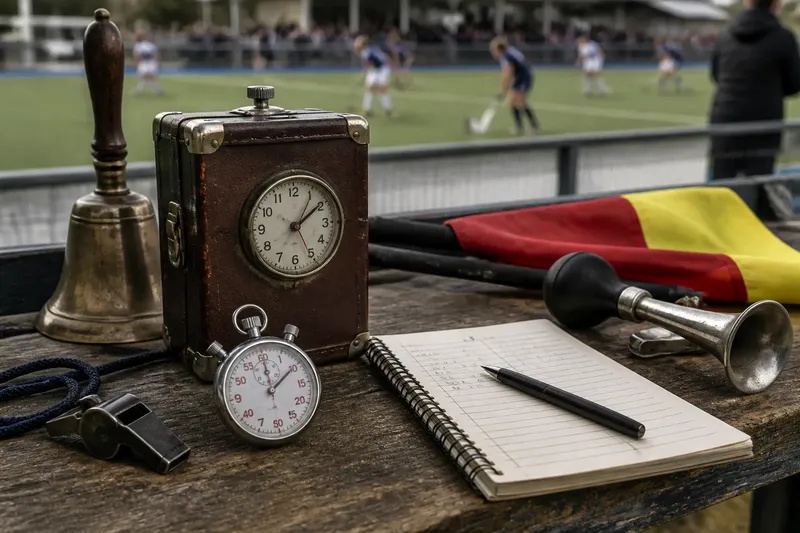
The common mistake is to assume a match clock has always meant a public scoreboard counting down. The history of the match clock is less a single march toward a display than a set of ways to coordinate time: an agreed signal, a timepiece managed by an official, or a clock the crowd can see.
Those methods can coexist. A whistle can announce an ending while a timekeeper tracks the period, and a scoreboard can show the audience what the officials are managing. The distinction is useful because the visible number and the authority to end play are not always the same thing.
How could a contest mark time without a visible clock?
Without a public running display, organizers could use an agreed cue to announce a start, pause, or finish. That cue might be a bell, horn, drum, shouted call, or official’s signal; which one mattered depended on the event and its customs. There was no single arrangement used by every sport.
A signal marks a moment, but it does not show how much time remains. A referee’s call may tell players that a period has ended, while spectators who missed the sound may need an announcement or an explanation. Like a kitchen timer that rings only when it is done, a signal can mark the endpoint without showing the countdown.
For historical claims about a particular sport, look for its dated rules or accounts rather than assuming that every early contest used the same cue. Without a named example and supporting record, it is safer to describe signals as one possible way of coordinating an event, not a universal stage that all games passed through.
What did an official timekeeper add?
A timekeeper with a watch or another timepiece could track a period continuously, even if no clock was visible from the field or stands. The timekeeper’s role was distinct from the referee’s or umpire’s: one maintained the time record, while the match official applied the rules and managed play.
The specific duties depend on the sport. A rule may assign an official responsibility for stopping or restarting time, or for signaling when a period ends. The important distinction is not that the timekeeper replaced other signals, but that a designated person had a means of tracking time beyond a start or finish cue.
Imagine a fictional field hockey match in which the appointed timekeeper tracks the period on a watch and signals the umpire when the rules call for an ending cue. The umpire uses that signal to manage play, while spectators on the far touchline cannot see the watch. The result is a time record for officials without a public countdown.
What changed when spectators could see match time?
A visible clock gave people in a larger venue a shared reference as play unfolded. Spectators no longer had to rely only on an announcement to know the displayed time, and players could also consult it when it was visible from the field. The display did not, by itself, determine who had authority over the clock.
That shared reference can help viewers understand why teams change their approach near the end of a period. A side protecting a lead may choose to keep possession, while a team behind may take more risks. The clock gives context to those choices; it does not tell viewers which tactic a team will choose.
Some sports make the official timekeeping process authoritative and use the public display to inform the crowd. If a display appears to disagree with an official signal, the relevant rules and the responsible officials determine what counts. The audience sees a useful reading, not necessarily the final ruling.
How should you read a match clock?
Check the sport’s rules or venue instructions when you need a precise answer, especially if the clock pauses or seems out of step with play. For a quick reading, these checks can help:
- Check who is responsible for official time. If the rules name a timekeeper or match official, treat that process as authoritative; if they do not, consult the sport’s rulebook or ask a qualified official rather than assuming the scoreboard decides.
- Check what the display labels. If it shows a period and remaining time, read it as a countdown for that period; if the display is unlabeled or unclear, use the venue’s explanation before interpreting the number.
- Check whether play is stopped or continuing. If the sport’s rules stop time for a particular interruption, expect the clock to pause; if time runs through that interruption, keep following the displayed clock rather than expecting it to freeze.
- Check which signal ends the period. If the rules specify a whistle, horn, or official call, wait for that cue; if the signal seems to conflict with the display, defer to the responsible official and the sport’s rules.
- Check whether the clock is public or managed privately. If spectators can see a display, use it as a shared reference; if only an official has a timepiece, rely on announcements or official signals for updates.
- Check whether the displayed time has a stated format. If the venue identifies it as elapsed or remaining time, interpret it accordingly; if no format is given, do not infer which way the clock counts from the numbers alone.
Say you are watching an invented indoor match. The venue identifies its display as remaining time, the rules say the timekeeper manages the official record, and a horn signals the period’s end. You see the display stop during an interruption: the rulebook says that kind of stoppage pauses time, so you read the frozen number as remaining time and wait for the horn rather than treating the display alone as the ending. If the rules instead said the clock continued during that interruption, the same frozen display would call for an explanation from the venue or officials, not an assumption about the period’s status.
Why do match clocks work differently across sports?
Sports set different rules for periods, interruptions, and endings. Some pause a clock for specified events; others allow it to run. A display may show elapsed time or time remaining, and the official signal may matter even when the number appears to reach its endpoint.
That is why a familiar scoreboard can mislead a new viewer. A shrinking number does not tell you which interruptions stop play, who controls the official time, or what confirms the period’s end. The sport’s rules settle those questions; the display helps you follow the format those rules create.
What do viewers ask about the match clock?
Did every sport use a referee’s whistle to end play?
No single custom applied everywhere. A whistle was one possible signal, while particular events could use other cues or conventions.
Does the scoreboard clock always decide when time is up?
Not necessarily. The sport’s rules and official timekeeping process determine what counts, so a scoreboard may inform viewers without replacing the responsible official.
Why can a clock stop during a match?
Some sports pause time for specified interruptions, while others let the clock run. The rule depends on the sport, not on a universal feature of scoreboards.
Why show time publicly if officials already keep it?
A public display lets spectators follow the match’s timing without waiting for an announcement. Officials still apply the rules, while the crowd gains a shared reference.
What should you notice the next time you watch?
The match clock makes a period easier to follow, but its meaning depends on the rules and the people responsible for timekeeping. Signals communicate decisions, timekeepers maintain an official record, and visible displays help spectators share the timeline; any one match may use more than one of these.
Next time you watch, check whether the display counts up or down, then listen for the signal that ends the period. That small habit helps you distinguish what the crowd can see from what the rules and officials control.